


Key Takeaways
- Businesses exploring Onfido alternatives often compare accuracy, automation capabilities, and global document coverage.
- The leading Onfido competitors offer document verification, biometric authentication, and fraud detection tools to support secure and scalable onboarding.
- AU10TIX stands out among Onfido alternatives for its automation capabilities and global scalability.
- Choosing the right identity verification solution depends on integration flexibility, regulatory coverage, and scalability.
Introduction
Overview of Identity Verification Importance
In today’s digital economy, verifying a customer’s identity has become a core part of secure onboarding. Banks, fintech companies, marketplaces, and travel platforms all rely on identity verification to confirm user identities, reduce fraud risk at scale, and meet regulatory requirements.
Modern businesses increasingly rely on automated verification tools that combine document authentication, biometric verification, and fraud detection signals, helping address newer threats such as deepfakes and injection attacks. For a deeper explanation of how identity verification works in practice, you can explore this guide to secure digital ID verification.
These technologies allow organizations to verify users quickly while maintaining a smooth onboarding experience. To understand the technology behind these processes, you can also explore how digital identity verification works.
Brief Introduction to Onfido and Its Market Position
Onfido, now part of Entrust, has been a recognized player in the identity verification industry for more than a decade. The company built its reputation around biometric verification, document analysis, and machine-learning-driven fraud detection.
Its technology is widely used by fintech startups, mobility platforms, and digital services. However, as the identity verification market evolves, many organizations evaluate Onfido alternatives that offer different capabilities, pricing models, or automation features.
The Need for Exploring Onfido Alternatives
Every business has different verification requirements depending on geography, industry regulations, and customer volume. For some organizations, this means evaluating Onfido competitors that offer stronger automation, broader document coverage, or more flexible integrations.
When comparing vendors, companies typically focus on the reliability of the identity verification solution, its ability to scale globally, and how easily it integrates with existing onboarding workflows.
How to Compare Identity Verification Solutions
Organizations evaluating Onfido alternatives typically compare vendors across several technical and operational criteria. Understanding these evaluation factors can help teams select the right partner for their identity verification strategy.
Verification Performance
Accuracy is one of the most important factors in any identity verification solution. False positives can block legitimate users, while false negatives increase fraud risk. High-performing vendors rely on AI-driven document authentication, biometric matching, and fraud signal analysis to maintain accuracy across large verification volumes.
Global Document Coverage
Businesses operating internationally need support for thousands of government-issued documents across many countries. Leading providers offer broad document coverage along with localization capabilities that allow identity checks to work across different regions and languages.
Liveness Detection and Fraud Prevention
Advanced identity verification vendors combine facial recognition with liveness detection technology to prevent spoofing attempts using photos, masks, or synthetic identities. Fraud detection tools may also analyze device intelligence, behavioral patterns, and document anomalies.
APIs and Integration Flexibility
Integration capabilities are another important factor. Modern digital identity verification solutions provide APIs, SDKs, and workflow tools that allow identity checks to be embedded directly into apps and onboarding flows.
Workflow Automation
Automation has become a major differentiator among Onfido competitors. Platforms that automate verification decisions reduce manual review workloads while helping businesses handle large spikes in onboarding activity.
Top 8 Alternatives to Onfido
1. AU10TIX
AU10TIX provides automated identity verification and fraud detection technology designed for organizations operating at global scale. Its technology focuses on eliminating manual review queues while maintaining high verification accuracy.
Pros
- Fast and accurate verification
- Strong global compliance coverage
- Enterprise scalability
Cons
- Best suited for mid-to-large organizations
- Advanced capabilities may require onboarding support
Ideal Use Cases
Global platforms in finance, travel, marketplaces, and digital services that require fast, automated verification.
2. Sumsub
Sumsub offers end-to-end KYC, KYB, and AML solutions with strong coverage across Europe and Asia.
Pros
- Comprehensive compliance tools
- Strong international document coverage
- Fast onboarding speeds
Cons
- Interface may feel complex for smaller teams
- Pricing may not suit early-stage startups
Ideal Use Cases
Crypto exchanges, fintech platforms, and regulated financial services.
3. Veriff
Veriff focuses on real-time identity verification with strong global document coverage.
Pros
- Fast verification speeds
- Strong fraud detection capabilities
- Easy API integration
Cons
- Pricing tiers may be expensive
- Support availability varies by plan
Ideal Use Cases
Marketplaces, mobility platforms, and global consumer apps.
4. iDenfy
iDenfy provides biometric authentication and document verification with flexible pricing models.
Pros
- Affordable pricing
- Easy integration
- Manual fallback verification available
Cons
- Limited brand recognition
- Smaller feature set compared to larger vendors
Ideal Use Cases
Startups and growing online businesses.
5. Trulioo
Trulioo offers identity verification supported by global data sources and compliance tools.
Pros
- Strong international coverage
- Compliance support
- Scalable infrastructure
Cons
- Initial setup may require technical resources
- Less suited for small businesses
Ideal Use Cases
Large organizations operating across multiple countries.
6. Persona
Persona provides customizable identity verification workflows designed for flexibility.
Pros
- Highly configurable verification flows
- Strong privacy controls
- Flexible implementation
Cons
- Requires more developer resources
- Setup complexity for smaller teams
Ideal Use Cases
Companies building highly customized onboarding journeys.
7. Jumio
Jumio combines AI-driven identity verification with fraud detection and compliance tools.
Pros
- Strong fraud detection capabilities
- Global document coverage
- Established industry presence
Cons
- Higher pricing
- Some legacy infrastructure components
Ideal Use Cases
Financial institutions and travel platforms.
8. Socure
Socure uses predictive analytics to improve identity verification accuracy in the U.S. market.
Pros
- High verification accuracy
- Low false positive rates
- Strong presence in fintech
Cons
- Primarily focused on the U.S. market
- Not ideal for smaller startups
Ideal Use Cases
U.S. financial institutions and credit platforms.
Why Choose AU10TIX for Identity Verification
Identity Verification is a strategic investment. Here’s why AU10TIX is a standout among Onfido alternatives.
Advanced Technology and Accuracy
AU10TIX uses cutting-edge machine learning for fast and highly accurate identity verification. There are no manual review queues, just fast results.
Comprehensive Compliance Coverage
AU10TIX stays ahead of regulatory shifts worldwide. Whether it’s GDPR, CCPA, or KYC/AML frameworks, the platform ensures your business remains compliant.
Seamless Integration and User Experience
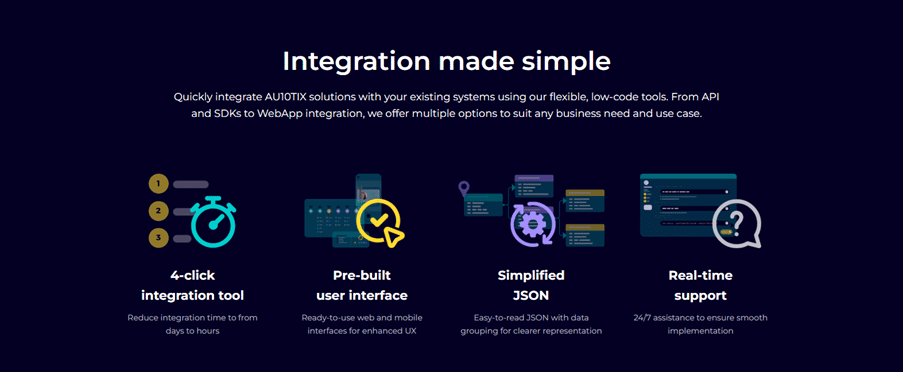
With easy-to-use APIs, AU10TIX integrates smoothly into your existing stack. The platform supports a smooth onboarding process, preserving UX across devices.
Competitive Pricing and Scalability
As your business scales, AU10TIX scales with you. Whether you need to verify hundreds or millions of users, their platform and pricing adapt to your needs.
Testimonials and Case Studies
Industry leaders across banking, travel, gaming, and e-commerce have trusted AU10TIX to streamline onboarding and reduce fraud. One case study from the fintech industry shows a 29% surge in conversion rates.